
The artificial intelligence industry has a massive fragmentation problem. Every week, a new state-of-the-art Large Language Model (LLM) drops. On Monday, Anthropic releases a new Claude variant. On Wednesday, Google updates Gemini. By Friday, DeepSeek or Mistral open-sources a model that beats them all on cost.
For developers and product managers, this rapid innovation is exhausting. Keeping up means constantly rewriting API integrations, managing a dozen different billing dashboards, and praying that your primary provider doesn’t suffer an unexpected outage. You want to build AI features, but instead, you spend half your sprint managing “API spaghetti.”
This is the exact friction that OpenRouter was built to eliminate.
In 2026, OpenRouter has cemented itself as a foundational layer of the modern AI tech stack. But what exactly is it? How does it work under the hood? And why are so many developers abandoning native provider APIs to route their traffic through a third party? Here is the hype-free, deep-dive breakdown.
1. The Core Concept: What Exactly is OpenRouter?
OpenRouter is an AI model aggregator and unified API gateway. It acts as a universal adapter between your application and the world’s LLMs.
The easiest way to understand it is through a travel analogy: Think of OpenRouter as Expedia for AI models.
If you want to fly, you could go to the Delta website, create an account, enter your credit card, and buy a ticket. Then, for your next trip, you go to United’s website and do it all over again. Or, you can just go to Expedia, search for flights across all airlines, and book whatever is cheapest or fastest using a single account.
OpenRouter does this for code. It provides a single, standardized API endpoint that gives you instant access to over 500 different AI models from more than 60 providers—including OpenAI, Anthropic, Google, Meta (Llama), xAI (Grok), and dozens of open-source hosts. You authenticate once, you pay one bill, and you get access to the entire ecosystem.
2. The Fragmentation Problem: Why Developers Use OpenRouter
To understand why OpenRouter is so popular, you have to look at the massive headaches it solves for engineering teams.
A. Eliminating Vendor Lock-in
When you build an application natively on the OpenAI API, your code becomes tightly coupled to OpenAI’s specific quirks, tool-calling schemas, and SDKs. If a competitor releases a model that is 10x cheaper and twice as fast, switching your app over is a massive refactoring headache. OpenRouter makes you completely model-agnostic. Because it uses an OpenAI-compatible endpoint format, switching from GPT-4o to Claude 3.5 Sonnet requires changing exactly one line of code: the model string.
B. Intelligent Fallbacks and Uptime
AI APIs go down. It is a fact of life. If you rely solely on Anthropic and their servers crash, your app crashes. OpenRouter allows you to configure automatic fallbacks. If your request to Claude fails due to an outage or a rate limit, OpenRouter will instantly, silently reroute the request to a backup model of your choosing (like Google Gemini or a hosted Llama model) so your users never see an error screen.
C. Consolidated Billing
Accounting departments hate AI development. Tracking API spending across six different corporate credit cards on six different platforms is a nightmare. OpenRouter unifies all of your AI usage into a single, itemized dashboard and one monthly invoice. You can see exactly how many tokens your team spent on OpenAI versus Mistral in a single glance.
3. How OpenRouter Actually Works (Under the Hood)
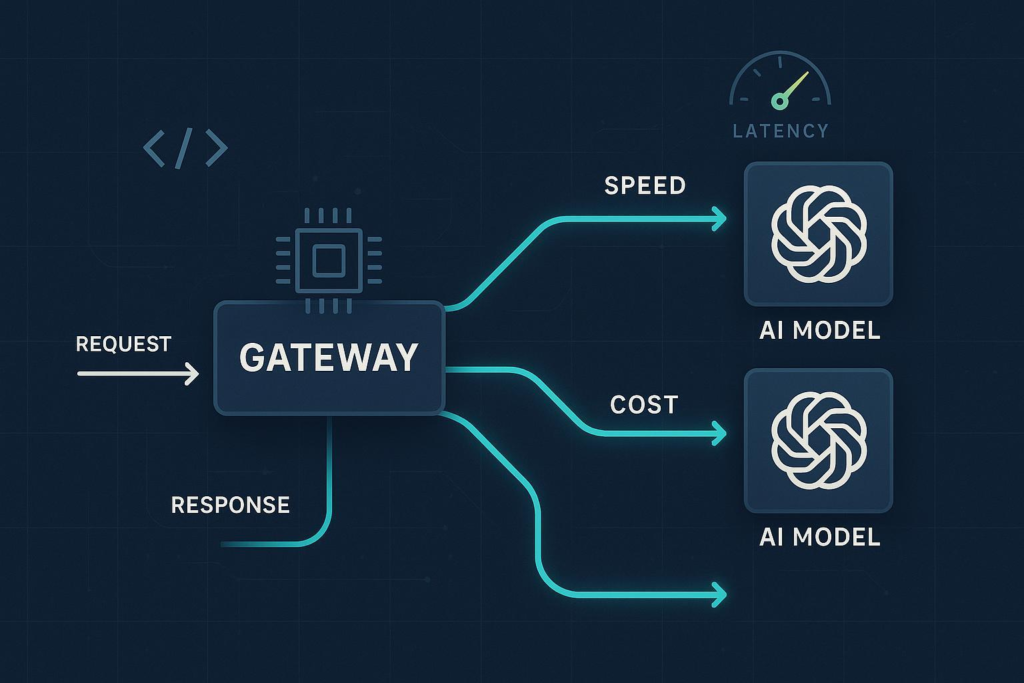
OpenRouter is not an LLM. It does not train models. It is strictly a routing and infrastructure layer. When your application makes a request, here is the architecture of what happens in about 20 milliseconds:
- Layer 1: The Request. Your code sends a standard JSON payload (formatted identically to an OpenAI request) to
openrouter.ai/api/v1/chat/completions. You specify the model, like"anthropic/claude-3-sonnet". - Layer 2: The Router. OpenRouter’s edge network receives the request. It checks your API key, verifies your credit balance, and evaluates the real-time health of the providers that host the requested model.
- Layer 3: The Dispatch. OpenRouter forwards your request to the actual provider (e.g., Anthropic’s servers, or a third-party host like Together AI if you requested an open-source model).
- Layer 4: The Normalization. The provider sends the response back to OpenRouter. OpenRouter normalizes the data format to ensure it matches the standard schema, and streams it back to your application.
The “Auto Exacto” Quality Routing (2026 Update)
As the platform evolved, OpenRouter noticed a massive issue: not all API hosts are created equal. If you request an open-source model like Llama 3, there might be five different companies hosting it. Sometimes, cheaper hosts drop tool-calling schemas or have higher latency.
To combat this, OpenRouter introduced Exacto Endpoints. By observing billions of requests, OpenRouter tracks which specific hardware providers have the highest tool-use success rates and the lowest latency. When you enable exacto routing, OpenRouter doesn’t just find the model; it dynamically routes your prompt to the highest-quality physical server hosting that model at that exact second.
4. Pricing: The Zero-Markup Promise vs. BYOK
One of the biggest misconceptions about OpenRouter is that it is a middleman that artificially inflates the price of API calls. This is false. OpenRouter operates on two distinct pricing models:
The Standard Model (Zero Markup)
If you use OpenRouter’s API keys to access commercial models (like OpenAI or Anthropic), you pay the exact same per-token price as you would if you went directly to the provider. OpenRouter passes the cost through with zero markup. They make their money through volume discounts negotiated with the providers, acting as a massive wholesale buyer.
Bring Your Own Key (BYOK)
If you have a special enterprise agreement with OpenAI, or you have massive credit grants from Microsoft Azure, you don’t want to pay OpenRouter for tokens. OpenRouter supports BYOK. You plug your own OpenAI or Anthropic API keys into your OpenRouter dashboard. OpenRouter will route your traffic using your keys, and they charge a nominal flat 5% service fee for acting as the infrastructure layer.
5. Head-to-Head: OpenRouter vs. The Alternatives
OpenRouter isn’t the only gateway in town. Depending on your project’s scale, you might be considering other options. Here is how they stack up in 2026:
| Feature | OpenRouter | Vercel AI Gateway | LiteLLM |
|---|---|---|---|
| Primary Use Case | Universal access, model discovery, agentic workflows. | Frontend dev, Next.js integration. | Enterprise internal routing, self-hosted proxy. |
| Architecture | Managed Cloud Service. | Managed Cloud Service (Vercel ecosystem). | Open-Source (Self-hosted or managed). |
| Model Catalog | Massive (500+ models). | Curated (Top-tier providers only). | Extensive (Whatever you configure). |
| Billing | Consolidated (OpenRouter bills you). | Bring Your Own Keys (You pay providers). | Bring Your Own Keys (You pay providers). |
| Enterprise Data Privacy | Good, but adds a network hop. No VPC options. | Standard cloud privacy. | Excellent (Can run inside your own VPC). |
When NOT to use OpenRouter
While OpenRouter is incredible for rapid prototyping, indie hackers, and agentic tools (like bridging Claude Code to DeepSeek), it has limitations in ultra-strict enterprise environments. Because every request routes through OpenRouter’s servers before hitting the LLM, it introduces an extra network hop (adding slight latency). Furthermore, healthcare or finance companies with strict data residency requirements often cannot use a managed cloud proxy and must opt for self-hosted gateways like LiteLLM.
6. How to Integrate OpenRouter (Python Example)
Because OpenRouter is intentionally designed to mimic OpenAI’s API structure, integration takes seconds. Here is how you do it using the standard Python openai SDK:
import os
from openai import OpenAI

# 1. Initialize the client pointing to OpenRouter instead of OpenAI
client = OpenAI(
  base_url="https://openrouter.ai/api/v1",
  api_key=os.getenv("OPENROUTER_API_KEY"),
)

# 2. Make your request using the provider/model syntax
completion = client.chat.completions.create(
  model="google/gemini-2.5-pro", # Easily swap to "anthropic/claude-3-sonnet"
  messages=[
    {"role": "user", "content": "Explain the concept of AI routing."}
  ]
)

print(completion.choices[0].message.content)
Notice the only changes are the base_url and the model naming convention (provider/model-name). The rest of your code—including tools, structured JSON outputs, and message arrays—remains identical.
7. Frequently Asked Questions (FAQs)
Is OpenRouter free to use?
OpenRouter itself does not charge a subscription fee. You pay for the tokens you consume. However, OpenRouter does host several completely free, open-source models (like certain Llama or Mistral variants) supported by the community or ad-hoc providers. You can filter the OpenRouter catalog specifically for “Free” models to experiment without spending a dime.
Does OpenRouter train on my data?
No. OpenRouter acts purely as a passthrough gateway. Their terms of service explicitly state they do not log your prompts or completions for training purposes. However, you are still subject to the data privacy policies of the underlying provider you choose to route to (e.g., if you route to OpenAI, OpenAI’s API privacy policies apply).
Can OpenRouter handle image generation or multimodal inputs?
Yes. OpenRouter supports multimodal models. You can pass base64-encoded images or image URLs to models like GPT-4o or Claude 3.5 Sonnet through the OpenRouter API exactly as you would natively. They also support routing to image generation endpoints.
What happens if a provider changes their API format?
This is OpenRouter’s job to manage. When Anthropic introduces a new way to handle system prompts, or Google changes their tool-calling syntax, OpenRouter’s engineers update their normalization layer. From your perspective, the API remains completely stable and OpenAI-compatible. OpenRouter absorbs the breaking changes so your app doesn’t have to.
The Final Verdict
In the rapidly shifting landscape of 2026, tying your application’s architecture to a single AI provider is a strategic mistake. Models become obsolete in months, and pricing wars are constant. OpenRouter abstracts away the chaos of the AI market, allowing you to treat intelligence as a commoditized utility. Whether you are building an autonomous coding agent, a dynamic chatbot, or a complex multi-step workflow, OpenRouter is the smartest way to future-proof your codebase.

