
The developer tool ecosystem experienced a seismic shift when Anthropic released Claude Code. By bringing agentic, autonomous AI directly into the terminal, they eliminated the context-switching friction that plagued earlier IDE plugins. However, this power came with a significant catch: you were locked into Anthropic’s proprietary billing and limited strictly to the Claude model family.
For independent developers, boutique agencies, and enterprise teams managing complex AI budgets, vendor lock-in is a liability. That is where OpenRouter enters the equation.
Over the past few months, the developer community has successfully engineered ways to bridge Claude Code’s powerful reasoning engine with OpenRouter’s massive model aggregator. This integration—often referred to as “Model Freedom”—allows you to execute Claude Code workflows using over 300 different LLMs, including Google Gemini, DeepSeek V3, Qwen, and even local open-source models.
In this comprehensive guide, we will break down exactly how this integration works, the different methods to configure it (from native overrides to dedicated proxies like CCORP and Claude Code Router), and which alternative models actually have the reasoning chops to handle agentic coding tasks.
1. Understanding the Baseline: What is Claude Code?
Before diving into the OpenRouter integration, we need to establish why developers are fighting so hard to hack this specific tool. Claude Code is not just another autocomplete wrapper. It is a terminal-native AI agent designed to execute complex, multi-step engineering tasks autonomously.
When you run claude in your terminal, the agent can:
- Read your entire local repository architecture.
- Execute shell commands (e.g.,
npm run testorgrep). - Edit files natively without requiring manual copy-pasting.
- Review Git diffs and author commit messages.
The magic of Claude Code is its execution loop. It relies heavily on tool-calling and structured output to evaluate its own work. Originally, Anthropic optimized this execution loop specifically for Claude 3.7 Sonnet. But as developers quickly realized, the execution loop itself is just software—and if you can point that software to a different brain, the possibilities explode.
2. The Problem: Vendor Lock-In and API Exhaustion
If Claude 3.7 Sonnet is currently the best coding model in the world, why would anyone want to route Claude Code through OpenRouter to use different models? The answers boil down to three massive friction points:
A. Cost and Rate Limits
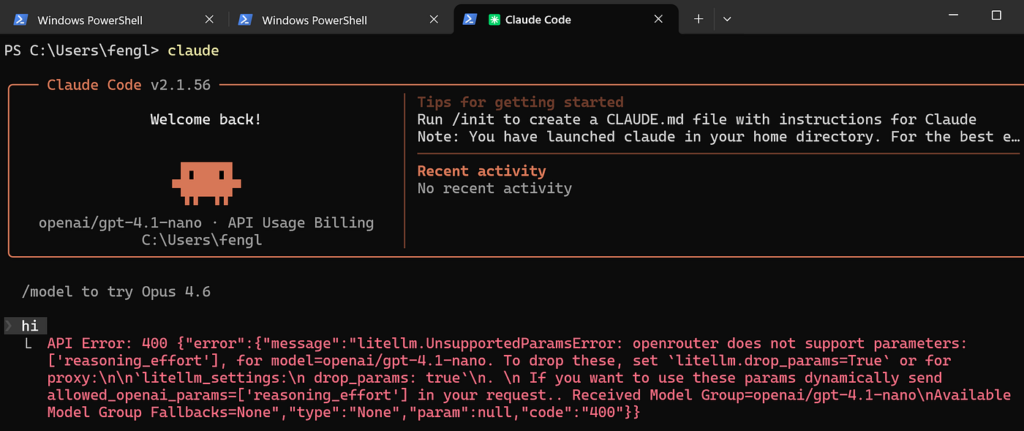
Agentic coding burns through tokens aggressively. Because Claude Code acts autonomously, a single command like “refactor the authentication flow to use OAuth2” might result in a dozen internal API calls as the agent reads files, writes code, tests the code, reads the error logs, and rewrites the code. Using native Anthropic API keys can drain a developer’s wallet overnight, and hitting the dreaded 429 RESOURCE_EXHAUSTED rate limit mid-task is infuriating.
B. The Need for Specialized Reasoning
While Sonnet is exceptional at general web development, it has blind spots. Sometimes you need the hyper-specialized math and logic capabilities of DeepSeek-R1, or the massive 2-million token context window of Google Gemini 2.5 Pro to digest an entire monolithic legacy codebase.
C. Unified Enterprise Billing
For development teams, managing separate API subscriptions for OpenAI, Anthropic, Google, and Mistral is an accounting nightmare. OpenRouter solves this by acting as a single, centralized gateway. You fund one account, and your team gets access to every model on the market.
3. How OpenRouter Hacks the Claude Code CLI
The integration between Claude Code and OpenRouter relies on intercepting the API calls that the CLI attempts to send to Anthropic’s servers, and redirecting them to OpenRouter’s servers instead. Because OpenRouter features an “Anthropic Skin” (meaning it can accept Anthropic-formatted API requests and translate them on the fly), this redirection is remarkably seamless.
There are currently two primary methods developers use to achieve this in 2026: The Native Environment Override and The Proxy Server (CCR/CCORP).
Method 1: The Native Environment Override (The Easy Way)
Anthropic quietly allowed developers to override the default API endpoint. By leveraging standard environment variables, you can force Claude Code to talk to OpenRouter directly.
- Clear your native key: Ensure your
ANTHROPIC_API_KEYis explicitly set to an empty string to prevent the CLI from defaulting to Anthropic’s billing. - Set the OpenRouter endpoint: Export
ANTHROPIC_BASE_URL=https://openrouter.ai/api. - Inject the OpenRouter Key: Provide your OpenRouter API key as the authorization token.
Note: While simple, this method limits your ability to dynamically switch models mid-session without restarting your terminal, as it relies heavily on OpenRouter’s default routing parameters.
Method 2: Claude Code Router (CCR) & CCORP (The Professional Way)
For power users, the open-source community developed middleware proxies. Tools like CCORP (Claude Code OpenRouter Proxy) and Claude Code Router (CCR) run locally on your machine (e.g., on localhost:3000).
These proxies sit between Claude Code and OpenRouter. You configure Claude Code to point to localhost, and the proxy handles the rest.
Why use a proxy?
- Model Aliasing: You can map Claude Code’s internal model requests to completely different models. For example, you can tell the proxy: “Whenever Claude Code asks for ‘claude-3-haiku’, give it ‘qwen-2.5-coder’ via OpenRouter instead.”
- Telemetry and Cost Tracking: Using the
@openrouter/devtoolspackage, these proxies can spin up a beautiful web UI onlocalhost:4983, giving you a real-time dashboard of exactly how many tokens your agent is burning per step. - Fallback Logic: If an OpenRouter model goes down, the proxy can automatically fallback to a secondary model without crashing your CLI session.
4. Step-by-Step Setup Guide: Routing via Multi-Claude
If you don’t want to build a proxy from scratch, the easiest, most reliable method in 2026 is using the open-source npm package @leogomide/multi-claude. This tool provides a clean Terminal User Interface (TUI) to manage your connections.
Step 1: Install the CLI Tool
Open your terminal and install the package globally via npm:
npm install -g @leogomide/multi-claudeStep 2: Generate an OpenRouter Key
Navigate to openrouter.ai/keys. Create a new key and name it “Claude Code CLI”. Ensure your OpenRouter account is funded with credits.
Step 3: Launch and Configure
Run the tool in your terminal:
mclaudeThis will open an interactive TUI. Use your arrow keys to select “Add Provider”, choose “OpenRouter”, and paste your API key. The tool will automatically validate the key against OpenRouter’s endpoint.
Step 4: Select Your Model and Code
Once configured, mclaude will dynamically fetch the list of available models from OpenRouter. Select the model you want to use (e.g., deepseek/deepseek-v3). The TUI will automatically inject the correct environment variables and seamlessly launch the native Claude Code agent.
5. Which OpenRouter Models Actually Work with Claude Code?
Here is the reality check: Claude Code is highly optimized for Anthropic’s tool-calling syntax. If you route the CLI to a weaker model, the agent will hallucinate, fail to read files properly, or get stuck in infinite execution loops.
Based on extensive community testing on platforms like Reddit’s r/ClaudeCode and r/RooCode, here are the only OpenRouter models you should trust to drive the Claude Code CLI:
| Model via OpenRouter | Best Use Case | Tool Calling Reliability | Cost Efficiency |
|---|---|---|---|
| DeepSeek V3 (or R1) | Complex algorithm refactoring; mathematical logic. | High. Excellent at following strict JSON structures. | Exceptional. Often 10x cheaper than native Sonnet. |
| Google Gemini 2.5 Pro | Massive context ingestion. Analyzing whole repositories at once. | Very High. Seldom drops tool-calling schema. | Moderate. Great alternative when Anthropic is rate-limiting. |
| Qwen 2.5 Coder (32B) | Fast, iterative front-end tweaks. | Medium. Occasional hiccups on multi-step shell commands. | Incredible. Perfect for basic web dev tasks on a tight budget. |
| Anthropic Claude 3.7 Sonnet (via OR) | The gold standard. Production-grade agentic workflow. | Perfect. It is the native engine. | Low. You pay premium pricing, but gain OpenRouter’s unified billing. |
6. Cost Analysis: Native vs. OpenRouter
Let’s look at why the financial math drives developers to this setup. Assume an average coding session involves the agent reading 50,000 tokens of context and writing 2,000 tokens of code.
- Native Claude 3.7 Sonnet: ~$0.15 per input / ~$0.03 per output. Total session cost: ~$0.18.
- OpenRouter (DeepSeek V3): ~$0.007 per input / ~$0.005 per output. Total session cost: ~$0.012.
When you multiply that by 50 agentic loops a day, the native route costs nearly $10/day, while the OpenRouter/DeepSeek route costs under $1/day. Over a year, unlocking Model Freedom can save thousands of dollars per developer.
7. Best Practices for OpenRouter Agentic Workflows
If you are going to bypass the native Anthropic guardrails, you need to implement your own discipline to keep the AI from destroying your codebase.
A. Always Use Git Worktrees
Never let a non-native model loose on your main branch. When launching Claude Code via a proxy, use the isolated worktree flag (e.g., mclaude --worktree [name]). This sandboxes the agent’s file edits, allowing you to easily revert if the open-source model hallucinates and deletes your CSS.
B. Watch the Telemetry
If you are using the @openrouter/cli tools, keep the DevTools viewer open in your browser (localhost:4983). Weaker models have a tendency to get “stuck” in a tool-calling loop, repeatedly reading the same file and failing to execute an edit. The DevTools visualizer will show you this immediately, allowing you to hit Ctrl+C before you burn through your API credits.
C. Prime the Context Prompt
When using models like Gemini or Qwen through the Claude Code interface, give them explicit instructions on their first turn: “You are operating within the Claude Code CLI environment. Prioritize precise file reading and strictly adhere to the expected XML/JSON tool schemas.”
The Verdict: The Abstraction of the AI Layer
The integration of OpenRouter with Anthropic’s Claude Code represents a massive maturation in the AI development space. We are moving away from monolithic platforms where the UI and the underlying “brain” are intrinsically tied together.
By forcing Claude Code to accept OpenRouter’s API, developers are taking ownership of their toolchains. They get the absolute best-in-class terminal agent experience (designed by Anthropic), powered by the most cost-effective and task-appropriate intelligence on the market (routed by OpenRouter). If you are coding professionally in 2026, setting up this proxy is no longer a fringe hack—it is a mandatory optimization.
Frequently Asked Questions (FAQs)
Will Anthropic ban my account for using OpenRouter?
No. If you configure the integration correctly, you are not using Anthropic’s API infrastructure or billing at all. You are simply using their open-source CLI interface to send requests to OpenRouter’s servers. Your Anthropic API account remains untouched.
Why do I get an “Authentication Error” when starting the CLI?
This is the most common setup issue. It almost always means your ANTHROPIC_API_KEY environment variable is not totally empty. If the CLI detects even a fragment of a native key, it will attempt to authenticate with Anthropic instead of routing through your proxy to OpenRouter. Ensure you have run export ANTHROPIC_API_KEY="".
Can I still use the new “Extended Thinking” feature?
Yes, but it depends on the model. If you route via OpenRouter to a model that natively supports reasoning tokens (like DeepSeek-R1, or Claude 3.7 Sonnet via OpenRouter’s specific reasoning endpoint), the proxy will pass those reasoning tokens through. Tools like Roo Code and Claude Code Router (CCR) have recently updated their platforms to specifically handle extended thinking traces.
Is OpenRouter safe for proprietary enterprise code?
OpenRouter acts as a passthrough. They state that they do not train on your data, but you are still subject to the data privacy policies of the underlying model provider you route to. If you route to an OpenAI or Anthropic model via OpenRouter, standard zero-retention enterprise API policies generally apply, but you should always verify compliance with your company’s InfoSec team.

