

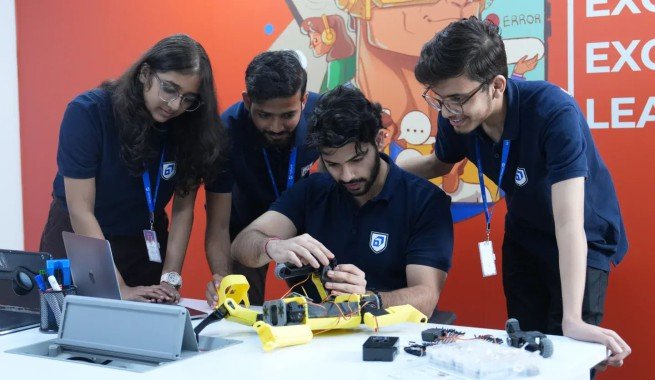
In a major shift for higher education in India, the Scaler School of Technology (SST) has officially launched a four-year, fully residential undergraduate (UG) program in Artificial Intelligence and Business. Located at their Bangalore campus, this interdisciplinary degree is explicitly designed to groom the next generation of tech entrepreneurs, product leaders, and innovators. By seamlessly blending rigorous computer science engineering with commercial strategy, Scaler is challenging the traditional boundaries that have long separated technology from business management.
The core philosophy driving this new initiative is that the era of artificial intelligence requires a new breed of professionals. Today, building a digital product does not require massive teams of developers and years of coding. AI tools have exponentially lowered the barrier to entry, allowing individuals to prototype and launch functional software in a matter of weeks. What dictates success in the modern digital economy is no longer just the ability to write code, but the capacity to identify pressing market problems, design sustainable solutions, and strategically scale a business around those solutions.
The Great Divide: Engineering vs. Business Schools
For decades, the higher education system has forced students into a rigid binary choice. If a student chooses an engineering school, they spend four years learning how to build complex systems, write algorithms, and manage databases. However, they graduate with little to no understanding of how to run a business, acquire users, or manage a profit and loss statement. They learn to build what someone else defines.
Conversely, students who attend business schools learn about market strategies, finance, operational efficiency, and organizational behavior. Yet, they lack the technical capability to actually build the products they are strategizing about. This disconnect often leads to friction in the corporate world, where technical teams and business teams speak entirely different languages.
The Scaler UG program in AI and Business eliminates this compromise entirely. It operates on the premise that the future belongs to those who can do both. Much like the modern entrepreneurial methodologies discussed when building founder-centric digital experiences, this program emphasizes a unified vision. A successful founder must have an intimate understanding of both the granular technical details of their product and the overarching market dynamics that will allow it to thrive.
A Deep Dive into the 4-Year “Build-First” Curriculum
Unlike traditional academic environments that rely heavily on theoretical lectures, exams, and rote memorization, Scaler’s approach is fundamentally hands-on. The curriculum is co-developed with over 100 industry leaders and is updated every six months to keep pace with the rapidly evolving tech landscape. Students will complete more than 50 real-world projects over their four years.
Year 1: Think and Build
The foundational year is designed to build core competencies across both domains. Students do not start with abstract business theories; they start by getting their hands dirty. The coursework covers programming fundamentals, data structures, applied mathematics for AI, economics, and structured communication.
Crucially, the learning is applied immediately through projects. First-year students are tasked with building interactive AI games (like an intelligent Tic-Tac-Toe), designing scalable database schemas for hypothetical apps like Amazon or MakeMyTrip, and creating tech-enabled e-commerce challenges. This ensures that the theoretical mathematics and coding principles are instantly grounded in real-world utility.
Year 2: Build Products That Scale
As students progress into their second year, the complexity increases significantly. The focus shifts from basic programming to production-grade systems. Students delve into AI model development, natural language processing, data pipelines, and the architecture required to support millions of users. Simultaneously, they begin learning go-to-market (GTM) fundamentals. It is not enough to build an AI tool; students must learn how to position it, market it, and understand user acquisition metrics.
Year 3: Solve Problems That Matter
The third year acts as a bridge between the classroom and the boardroom. The focus pivots sharply toward product strategy, growth levers, and navigating real-world constraints. Students spend significant time in the Scaler Innovation Lab, an incubator setting where they often work alongside early-stage startups.
This exposure is critical. By analyzing the competitive landscapes of emerging tech, tracking funding rounds on platforms like Crunchbase, and observing how actual founders pivot and adapt to market feedback, students gain an invaluable, unvarnished look at the realities of the startup ecosystem.
Year 4: Founder Mode
The capstone of the Scaler AI and Business program is its fourth year, intensely focused on what the institution calls “Founder Mode.” This is where the program truly separates itself from any other undergraduate degree in the country. Startup building is not an optional extracurricular activity or an after-school club; it is a mandatory academic requirement.
Every single student must conceptualize a business idea, build an AI-native Minimum Viable Product (MVP), and attempt to scale it. The goal is to take the venture from a mere idea to early traction and, ideally, initial revenue. The institution provides the necessary infrastructure, mentorship, and even access to a dedicated pre-seed capital pool of over ₹2 Crores to fund these student-led ventures.
Mentorship from the Top 1% of the Industry
A curriculum is only as good as the people teaching it. Scaler School of Technology boasts a faculty and mentorship roster comprising leaders who have built billion-dollar products. Students receive direct, 1:1 mentorship from founders, operators, and engineers from frontier tech companies like OpenAI, Meta, Google, NVIDIA, and McKinsey.
Having access to the minds behind platforms like ChatGPT 3.5 or Facebook Messenger provides students with insights that simply cannot be found in textbooks. Furthermore, fostering a mindset of continuous learning is heavily encouraged. Students are taught to seek inspiration and knowledge from a variety of sources, whether that means studying the visionary talks of global leaders through their TED profiles or mapping out creative brand identities and user experience visions using visual discovery engines like Pinterest.
Early Signals of Impact: Real Startups, Real Funding
Though the AI and Business program is newly formalized as a specific degree pathway, the ethos of building startups has already been tested within the Scaler ecosystem. The outcomes have been remarkable.
For example, NeoSapiens, a startup incubated at the Scaler Innovation Lab, successfully secured funding on the national television show Shark Tank India for building an AI-native wearable device. Another student venture, Percevia, won first place among 20,000 entries at the ‘Samsung Solve for Tomorrow’ competition by building AI-powered glasses designed to assist the visually impaired. These are not hypothetical business case studies; these are real teenagers building hardware and software that impacts lives and attracts venture capital.
The Ultimate Safety Net: Deferred Placements
One of the most significant barriers to entrepreneurship, particularly for young graduates, is the fear of failure and the associated financial risk. Scaler addresses this directly by designing the program with ambition and a built-in safety net.
If a student spends their fourth year building a startup but decides post-graduation that they do not want to continue running it—whether because the business failed to find a market fit, or they simply realized the founder lifestyle isn’t for them—they are not left out in the cold. Scaler provides deferred placement support.
These students can easily pivot into high-impact industry roles. Thanks to their rigorous technical and business training, they are highly sought after for positions such as AI Product Managers, AI Engineers, Strategy Consultants, or roles within a Founder’s Office. Scaler leverages its massive network of over 1,200 hiring partners, including MAANG companies and top-tier startups, to ensure graduates have lucrative traditional career pathways available to them.
Admissions, Cohort Exclusivity, and Campus Life
Scaler School of Technology operates a highly selective admissions process. For the inaugural cohort of the AI and Business program, the intake is strictly capped at 200 students. This ensures a low student-to-mentor ratio and fosters a highly concentrated environment of ambitious peers.
The admissions process is holistic. It begins with the National Scaler Entrance Test (NSET), which evaluates aptitude and logical reasoning. This is followed by two rounds of interviews: an AI-led interview assessing program fit, and an industry-led interview focused on evaluating the candidate’s curiosity, problem-solving ability, and genuine ambition for startup building.
The fully residential urban campus in Bangalore places students in the heart of India’s Silicon Valley. The environment is designed to be immersive, featuring 24/7 access to the Innovation Lab (equipped with 3D printers, robotics, and AR/VR tech), hackathons, industry networking events, and a vibrant student-driven culture that includes sports, music, and debate clubs.
Frequently Asked Questions (FAQs)
Conclusion: A Paradigm Shift in Tech Education
The launch of the Scaler UG program in AI and Business marks a pivotal moment in how we educate the next generation of innovators. By acknowledging that the future of commerce is intrinsically linked to artificial intelligence, and that the future of technology requires sound business fundamentals, Scaler is creating a blueprint for the modern founder.
For high school graduates who have ever dreamed of building the next disruptive tech giant, the traditional path of a pure engineering or pure business degree is becoming obsolete. The AI era demands interdisciplinary mastery. By providing the curriculum, the mentorship, the funding, and the safety net, Scaler School of Technology is not just teaching students about the future; it is actively funding them to build it.
Comments